
StepSense Analytical Cane

A project completed with Colin Heics, Hannah Lindsay, Martin Lui, and Benjamin Tan.
Time Frame: January-April 2011
The Problem:
A majority of medical devices used to collect patient data for canes and walkers require large expensive equipment that cannot be taken out of the lab.
Requirements:
- Strength: Most offset canes have a weight limit of 250 lbs, however this refers to the weight of the person using the cane. Typical cane loading for a 200 lbs adult male with a limp induced by differential leg lengths was less than 50 lbs when walking on a flat plane without fatigue. 1. Assuming a safety factor of 2, the cane must be able to have a loading of 100 lbs without damage to the device or the cane, as well as not have damage to the cane or the device when a shock load of 150 lbs is applied to the cane.
- Robustness: The cane must be able to endure the wear and tear it will endure under a
patients use. It is vital that if the device fails, it does not affect the strength of the cane. - Weight: The device should not increase the weight of the cane in excess of 10% of a typical cane. Lightweight canes may be used to facilitate achieving this requirement. This refers to one of the group members taking off one shoe while using the cane to simulate proper limping.
- Aesthetics: The cane must not have obvious protrusions and the average elderly patient
should be willing to use the device on a daily basis. Success will be measured based on how many people are accepting of the device’s appearance. - Power: The device be powered by a battery. It is required that the device is able to run for 2 days without charging while being used with a usage frequency typical of 95% of the potential market.
- Signalling: The device must send and/or save the data it collects during its use. Success will be measured by the device’s ability to save the collected data correctly, and is able to be retrieved by an operator
Concepts:

The stain gauge mounted onto the side of the cane will contract with the pressure applied from the user on the top of the cane.

A number of strain gauges are mounted on the inside of the cane. A ball pivot is inserted into the end of the cane that has a stick poking from the tip. As the user moves and puts pressure on the cane, the stick pushes against different strain gauges, allowing measurements to be taken of the angle and magnitude of the applied force.

A rod positioned inside the cane that pushed on a strain gauge mounted inside the cane. The spring constant on the installed spring will be the conversion factor from the strain gauge to the final digital force output.
The Prototype: The final design was chosen to be a mixture of the spring and rod design to measure the force the the user exerts onto the cane, and a number of accelerometers mounted on the outside of the cane to measure the pan and tilt of the cane during use.

Full view of device body.

Mounted Accelerometers on side of cane.

Cross-section of base of cane with rod and strain gauge to measure applied force.
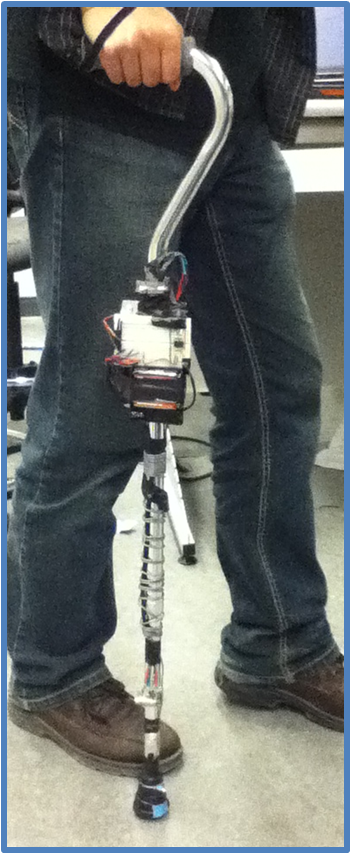
Accelerometers and strain gauge(load cell) mounted in cane are connected to a circuit that wirelessly transmits data via bluetooth to data acquisition system in computer for processing and analysis.
The Report:
 Yiling Wang